The impact of Cyclone Jasper
Disaster recovery is a big job! For North Queenslanders in particular, our community knows the struggle when it comes to fixing up the damage caused by storms, cyclones and floods. But when Cyclone Jasper hit in December 2023, the Cairns region was particularly affected. Landslips were a common occurrence, where the soils of the surrounding ranges became so saturated that their usual rock-solid structure turned to sludge. Once in this state, hillsides become mobile, and huge amounts of falling rock and debris demolish everything in their path
In 2024, the Queensland Government’s Department of Transport and Main Roads (TMR) was tasked with procuring and driving the repair works needed for many of the region’s roads. The Kuranda Range was badly damaged and has had several of its sections gouged out by landslips. A lot of repair engineering and construction work was called for and works commenced in November. To minimise impacts to road-users, the works are now largely being done at night-time, and this includes our role in the picture!
A big part of preparing a damaged road is the preliminary environmental approvals and engineering. Four Elements have been a part of this process by supporting SEE Civil contractors carrying out the on-ground works. In preparing for restructuring the roads, we have been conducting surveys for some of the rarest nocturnal critters that also use the area – the Kuranda Range frogs! By law, we have a duty to protect native wildlife, and this includes some of the trickiest ones to find and observe.
Our frogs are incredibly important. Not only are they a fantastic pest-control service to humans, but they also fulfil a vital functional niche in the environment, are an indicator species for times of environmental change, and hold strong First Nations cultural, contemporary tourism and recreational value. Among them, are three threatened frogs found on the Kuranda Range which are now protected from harm by both the State and Federal Governments. These species are the primary focus of our work with SEE Civil and TMR in driving the road recovery works forward in a sustainable and sensible way.
Kuranda tree-frog (Litoria myola)
This relatively large frog (well, by frog standards anyway – about 7cm!), is one of the rarest frogs in our region. The frog is found only near Kuranda in the Wet Tropics bioregion. It is severely threatened by the amphibian chytrid fungus (Batrachochytrium dendrobatidis), which infects the skin of frogs leading to chytridiomycosis where the salt-water balance collapses, ultimately leading to heart failure. This fungus has impacted frogs worldwide, but particularly in cooler, moist climates like those of the Wet Tropics ranges. The Kuranda tree-frog’s peak active season is around December to January, and it’s rapid “tic, tic, tic” call can be heard around this time in the localised area.

Common mist frog (Litoria rheocola)
Despite its name, this frog is also a protected species. The species used to be quite widespread and common throughout the Wet Tropics bioregion but has declined extensively due to amphibian chytrid fungus. The frog is now only found in lower elevation regions of its former habitat, where chytrid struggles to survive due to heat. The frog is much paler than the Kuranda tree-frog and lacks the strong jade-green colouration in and around the eye.

Australian lacelid (Litoria dayi)
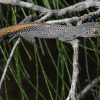
The third species of interest is the aptly named Australian lacelid. This gorgeous frog is about 6cm long and is a caramel-brown colour. Its large black eyes have a characteristic pattern of cream-coloured veins on the lower eyelid, which when blinking, are really striking! Like the common mist-frog above, this species used to be more common, but its range has dramatically shrunk due to the amphibian chytrid fungus. It is now only found in the lower ranges of its former habitat where heat supresses the infection.
Find out more about these amazing species on the FrogID website.
So, what are we doing to support SEE Civil, TMR and the frogs?
Since November 2024, 4 Elements have been conducting targeted threatened frog species surveys on behalf of the Kuranda Range recovery works. Multiple survey methods are being utilised to increase the likelihood of detection as per the Terrestrial Vertebrate Fauna Survey Guidelines for Queensland. This consists of active searches by spotlighting at night looking for “eye shine” and listening for calls to identify species (two rounds have been completed). We also use deployment of BioAcoustic Recorders (BARs), which record sound at specific intervals throughout the night using low noise omnidirectional microphones (one round is currently underway). The recorded data can be analysed through audio or by visually separating frog calls based on call structure, using appropriate software programs.

Our ecologist Jack has been donning his field gear and getting into some very tricky terrain to help the clients know more about, and do more to protect, the local threatened frogs.
Once we have collected all available data, we will be able to use the combination of audio, quantitative and qualitative information to develop Species Management Plans (SMPs) for SEE Civil and TMR. These can be used to ensure that the project’s potential impacts are avoided, or where unavoidable, minimised. Using alignment with both the State and Federal environmental legislation, we can put forward actions such as amended erosion and sediment control, timed avoidance areas and fencing, that will help safeguard amphibian habitats and known areas of occupancy.

As we see the impacts of a rapidly changing climate take a toll on our lives, we should spare a thought to those creatures bearing the brunt of it all. Amphibians the world over have been decimated by the chytrid fungus infection. Now, with increasingly severe and frequent storm seasons, their remaining habitats at lower elevations are being inundated and torn apart by storms, and then often drying out much too quickly for breeding to complete. These spikes in extremes are not good for nature, which has adapted to a less severe cycle of change over geological time.
At 4 Elements Consulting, we are committed to using the best available technology, science and professionals to help our clients achieve their goals, and in this case, rescue an important road, and make it safe again for future use. However, we also have our unique nature at the forefront of our minds when crafting solutions with our clients and we will do our utmost to forge positive outcomes for both.
If you need some help with a project, froggy or not, please do get in touch with us and we’d be happy to chat!