
What ESG stands for
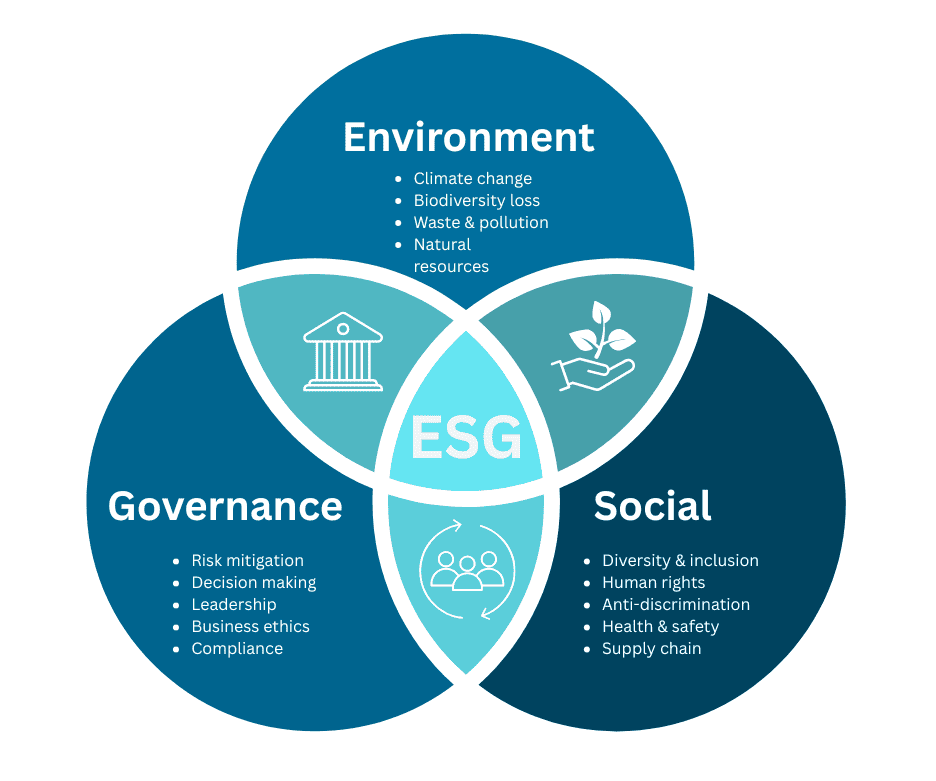
ESG is a framework that quantifies and measures the degree to which an organisation operates in a sustainable and responsible manner.
The three assessment criteria:
- Environmental – reducing environmental impact of business operations – minimising greenhouse gas emissions (energy efficiency), conserving natural resources (waste disposal strategy and reduced pollution), adopting eco-friendly practices
- Social – supporting employee wellbeing, promoting inclusion and diversity, fair labour practices (optimal working conditions), positive stakeholder relations (data security), investing in local communities (community donations)
- Governance – transparent, ethical and responsible management, reducing fraud risk, and ensuring legal compliance
How to navigate the new ESG mandatory reporting?
With the new regulations falling into place, requiring businesses to report their climate-related financial activities, many are worried about what this will mean for the future of their company. Environmental, Social and Governance frameworks (ESG) are not a new concept; many businesses have been operating with the concepts it cultivates for years. But it can be tricky to grasp. That’s why we’re here – to break down what ESG means, why it’s important and how you can implement it into your daily practices.
Why is an ESG Strategy important?
Australia introduced mandatory ESG reporting for large companies from 1 January 2025. This reporting is a result of the International Sustainability Standards Board (ISSB) being created at the UN’s Climate Change Conference (COP26) in 2021.
The ISSB incorporates investor-focused standards and reporting guidelines, aligned with both UN and Intergovernmental Panel on Climate Change recommendations. This means that the implementation is the first in a suite of phases of key science and policy that will affect how businesses operate in a world moving towards carbon neutrality.
For now, it only requires companies registered as a corporation, earning over $50 million in consolidated revenue, owning over $25 million in gross assets and with at least 100 employees. However, within the next 5-10 years, medium and small businesses will also be onboarded with mandatory reporting requirements.
It is important to get ahead of the game, even if you’re a medium or small enterprise, and start thinking about an ESG strategy. The key is to think about how you might align your environmental, social and governance frameworks with what will be required of your business in the future, and to look at how this affects your financials.
Why you should care about ESG strategies?
The ESG frameworks are the result of decades of scientific, social and political movement based on humanity’s increasing understanding of our own impacts on nature. Essentially, the ‘business as usual’ model is no longer working, with many of the most significant impacts of business requiring rethinking to reduce, or even neutralise, their effects on the environment.
Larger businesses with multi-national chains of commerce, employing high numbers of people and requiring large volumes of energy, are among the most significant when it comes to change.
Things like procurement strategies and how people are treated throughout business activities, travel and transport strategies, and management of waste are all integral to an ESG strategy and are key avenues that help alleviate our impacts on the natural world.
How are 4 Elements implementing sustainability planning and ESG strategies into our business practices?
Here at 4 Elements, we’re practising what we preach, and leading by example. As a business whose values are directly linked to the state of the environment, we have recently implemented a Sustainability Strategy that, when coupled with our Integrated Management Strategy, forms our current ESG framework.
We have incorporated a review of our current impacts on nature, people and planet, carried out a risk assessment of what avenues of change have the best effort-to-outcome ratios, and developed an action plan that includes signatory to the UN Global Compact, GreenKPI and Sumdays sustainability software, and office-based delegations to get things done.
Our Strategy is broadly grouped into emissions, waste and First Nations engagement. For emissions, we’re working to track, minimise and offset. For waste, we’re monitoring our outputs and focusing on avoidance and minimisation tactics. And, for Indigenous empowerment, we’re promoting financial support, language and social engagement right across our business activities.
Emissions
- Improving energy efficiency across offices and projects
- Striving towards Net Zero
- Measuring and reporting emissions
- Offsetting unavoidable emissions through certified programs
Waste & Pollution
- Reducing waste across operations
- Integrating improved recycling and circular economy practices
- Safely managing and disposing of hazardous materials
First Nations Support
- Undertake future internship, funding support and partnerships with Indigenous communities in the places we live and work
- Incorporating Indigenous species and place names into our reporting
- Providing cultural competence training for all staff

Your ESG partner: Practical guidance backed by real experience
At 4 Elements, one of the best ways we have learned to support other companies in their sustainability journeys is through our experience in completing our own. We are a signatory to the UN Global Compact and have an active Sustainability Strategy that guides the ways we do business. Some of our most important actions include emissions reduction and offsetting, waste and recycling policies and the incorporation of Indigenous knowledge and community empowerment.
Lead the Market With Actionable ESG Strategies
Organisations with strong sustainability credentials are more likely to outperform their competition in terms of profitability.
Allow us to handle the building of actionable guidelines to help ensure your company not only remains compliant but stays ahead of the game.
Call 1300 432 368 to speak with our team.
Or fill out the contact form & we will be in touch.
Start the Conversation
"*" indicates required fields